China’s lighting market offers many solar and main power solutions. Each option serves different sites, budgets, and operating conditions. This guide examines the China Top 10 Solar vs Main Power Lighting Differences with practical details.
Many buyers ask, “what is the difference between solar and main power lighting?” Solar lighting collects sunlight through a photovoltaic panel. It stores energy in a battery for nighttime use. Main power lighting receives electricity through a fixed grid connection. It usually provides steadier output when the weather changes.
Solar systems can reduce trenching, cabling, and monthly electricity costs. They suit remote roads, gardens, parking areas, and construction sites. A cloudy winter week may reduce charging performance. Battery quality also affects brightness, lifespan, and maintenance. Main power lighting often delivers stronger, more predictable illumination. However, installation may require wiring, protection equipment, and professional electrical work.
A reliable comparison should examine more than purchase price. Check lumen output, lighting hours, battery chemistry, panel efficiency, warranty terms, and ingress protection. Review real installation records, not only laboratory claims. Experienced suppliers should explain performance under local sunlight conditions. They should also provide clear testing documents and replacement guidance.
Small details matter. A shaded panel can change the result. A weak battery can disappoint quickly. No comparison is perfect. Solar lighting is not automatically cheaper, and grid lighting is not always simpler. Site surveys, seasonal data, and safety requirements should guide the final decision. This article compares ten practical differences to support a more informed purchasing choice.
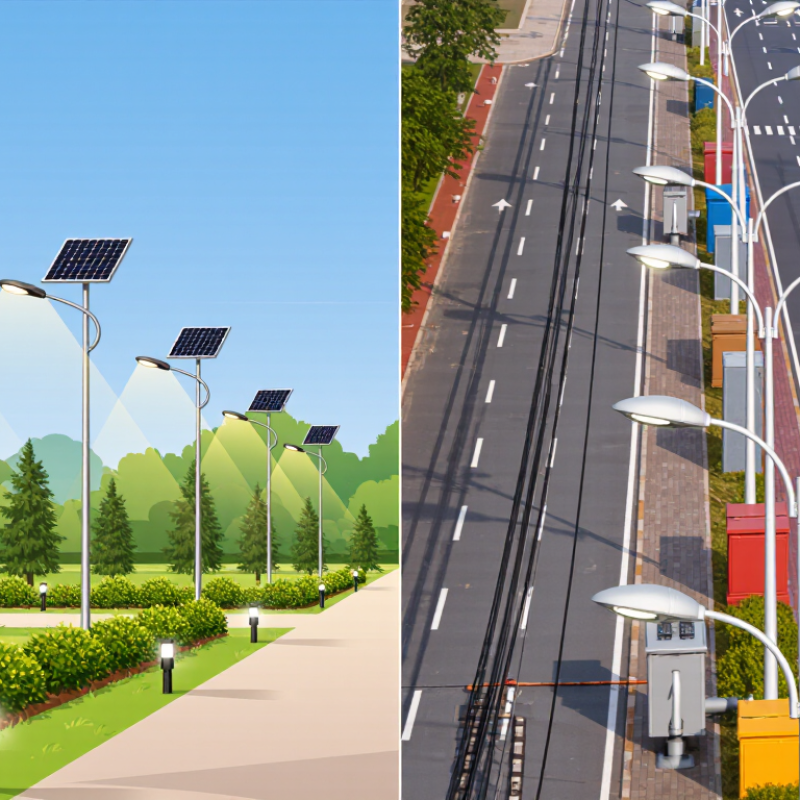
China’s top ten solar-versus-mains lighting differences begin with the power source. Solar fixtures collect sunlight, charge a battery, and usually deliver low-voltage DC power. Mains fixtures use China’s 220 V, 50 Hz grid through an AC driver. This affects wiring, insulation, connectors, and installation safety. Solar lighting also depends on battery capacity, panel size, sunlight, temperature, and nighttime demand. Mains lighting normally offers steadier brightness and longer operating hours. It can still fail during outages. A simple watt comparison can mislead.
The IEA PVPS Trends in Photovoltaic Applications 2024 report recorded 216.9 GW of new solar capacity in China during 2023. That growth supports wider solar-lighting adoption, but it does not remove practical limits. Battery aging, cloudy weather, dust, and winter charging reduce real output. The GOGLA Global Off-Grid Solar Market Report 2024 reported about 9.3 million solar energy kits sold globally in 2023, showing strong demand for independent lighting. However, product quality varies. In field planning, compare lumen output, battery autonomy, charging time, service access, lifecycle cost, controls, weather resistance, and replacement parts—not only purchase price.
Tips: For a solar project, measure three cloudy nights before selecting capacity. Keep emergency brightness below maximum output. For mains lighting, verify 220 V and 50 Hz compatibility, certified insulation, grounding, and driver temperature. I would also leave spare battery capacity; real weather is often less cooperative than the specification sheet.
The chart compares one 20 ms cycle of a 220 V RMS, 50 Hz mains waveform with a typical 24 V DC output used by standalone solar lighting systems. The solar line is shown as a steady DC level; actual solar-light voltage depends on the battery and controller design.
Technical note: 220 V RMS mains has an approximate peak voltage of ±311 V. The waveform is illustrative of a sinusoidal 50 Hz supply, while the 24 V solar trace represents a typical low-voltage DC battery bus rather than a universal solar-light specification.
China Top 10 Solar vs Main Power Lighting Differences?
Solar lighting begins with a local energy resource. Many regions receive about 1,000–2,000 kWh/m²/year of solar irradiation. This figure describes sunlight, not usable electricity. A photovoltaic panel converts only part of it, while temperature, dust, wiring, and battery losses reduce output. Field measurements matter more than a promising map.
Grid-powered lighting offers steadier operation after installation. It can support long overnight hours and high-power fixtures without large batteries. However, electricity costs may rise, and reliability depends on the local network. Solar systems can work independently during outages, but poor sizing causes dim lamps before dawn. That is a common design failure.
Practical comparisons should examine lighting hours, road width, weather, maintenance access, and winter conditions. A shaded installation may produce far less than the annual estimate. Battery replacement also changes the long-term cost. My first comparison was too neat; energy yield is never identical across every street. Engineers should record monthly irradiance and actual lamp runtime before approving a large project. The 1,000–2,000 kWh/m²/year range is useful, but it needs site validation.
| No. | Comparison Dimension | Solar-Powered Lighting | Main Power / Grid Lighting | Practical Difference |
|---|---|---|---|---|
| 1 | Primary Energy Source | Sunlight converted into electricity by photovoltaic modules. | Electricity supplied through the public power grid, mainly generated from a mix of thermal, hydro, nuclear, wind, and solar sources. | Solar lighting produces energy locally, while grid lighting depends on centralized generation and transmission. |
| 2 | Solar Resource and Electricity Yield | Many regions in China receive approximately 1,000–2,000 kWh/m²/year of global solar irradiation. With typical module efficiencies of about 18%–23% and system losses, electricity yield is roughly 135–390 kWh/m²/year. | Output is not limited by local sunlight at the lamp location. It is supplied according to grid generation capacity and network availability. | The 1,000–2,000 kWh/m²/year figure describes solar irradiation, not the direct electrical output of a PV panel. |
| 3 | Power Availability | Solar generation varies with daylight, weather, season, shading, and panel orientation. Battery storage is normally required for night operation. | Normally available day and night, subject to outages, maintenance, extreme weather, or grid restrictions. | Grid lighting offers more predictable continuous operation; solar lighting requires correct energy storage sizing. |
| 4 | Energy Storage | Uses rechargeable batteries, commonly lithium-based or lead-acid systems, to store daytime energy for nighttime use. | Usually does not require a dedicated battery at the lighting point because the grid balances supply and demand. | Solar systems need battery capacity, temperature management, and replacement planning; grid systems generally do not. |
| 5 | Installation Requirements | Requires PV modules, a charge controller, battery, LED luminaire, support structure, and suitable solar exposure. | Requires grid connection, cables, distribution equipment, protection devices, and often trenching or utility poles. | Solar is useful where grid extension is difficult; grid lighting is usually simpler where electrical infrastructure already exists. |
| 6 | Operating Cost | No routine electricity purchase is required after installation, but batteries, cleaning, inspections, and component replacement create operating costs. | Incurs ongoing electricity charges, demand-related costs in some applications, and network or maintenance expenses. | Solar can reduce long-term energy bills, while grid lighting may have lower initial complexity in developed areas. |
| 7 | Carbon and Local Emissions | Produces no direct combustion emissions during operation. Lifecycle emissions arise from manufacturing, transport, installation, and end-of-life processing. | Operational emissions depend on the electricity mix. Coal- and gas-based generation generally produces more emissions than renewable generation. | Solar lighting can reduce local emissions and grid electricity demand, although its total environmental impact is not zero. |
| 8 | Reliability Factors | Performance is affected by consecutive cloudy days, dust, snow, high temperatures, battery aging, and incorrect system sizing. | Performance is affected mainly by power outages, voltage fluctuations, damaged cables, grid congestion, and extreme weather. | Solar reliability depends on local climate and storage autonomy; grid reliability depends on the electrical network. |
| 9 | Lighting Control | Often uses automatic dusk-to-dawn control, motion detection, dimming, and battery protection to balance brightness with available energy. | Can support fixed schedules, centralized management, instant switching, dimming, and smart-network controls without depending on local battery charge. | Solar controls prioritize energy conservation; grid controls generally provide greater flexibility for high and constant lighting levels. |
| 10 | Best-Fit Applications | Remote roads, rural paths, parks, campuses, construction areas, isolated facilities, and locations where trenching is expensive or impractical. | Dense urban roads, tunnels, industrial sites, commercial areas, high-traffic routes, and applications requiring stable high output. | The better option depends on solar exposure, required operating hours, local grid access, load level, and total lifecycle cost. |
Technical note: Solar irradiation of 1,000–2,000 kWh/m²/year is a broad regional range in China, not a guaranteed value for every site. Actual PV electricity production depends on location, tilt, orientation, shading, module efficiency, temperature, system losses, and battery performance.
China’s top ten solar and mains-powered lighting differences become clearer when measured over ten years. LED modules rated at 130–200 lm/W can produce strong output with modest energy use. However, those figures often come from laboratory conditions. Real fixtures lose light through optics, drivers, heat, and dirt. A practical installed result may be closer to 100–160 lm/W.
Solar lighting avoids trenching, utility connections, and monthly electricity bills. That can reduce costs on remote roads, factory yards, and rural walkways. Yet the battery, controller, panel, and pole increase the initial purchase price. Battery replacement may become necessary during the ten-year period, especially in hot regions or locations with deep nightly discharge. Cloudy weeks also demand careful sizing. Small panels look efficient in brochures. They may struggle in winter.
Mains lighting usually offers stable output throughout the night and simpler maintenance access. Its long-term cost depends on tariffs, cable repairs, and outage exposure. Field teams should compare delivered lux, not lumens alone, using a calibrated meter after installation. A ten-year spreadsheet should include cleaning, battery changes, power consumption, and failed drivers.
Solar is not always cheaper. I have seen a low-energy design underperform because its battery reserve was too optimistic. I have also seen mains installation costs rise after unexpected excavation. Local sunlight data and actual maintenance records matter more than attractive efficiency claims.
Reliability becomes clearer when lighting must work through two or three dark nights. Solar lighting stores daytime energy in a battery, then supplies lamps after sunset. Its performance depends on battery capacity, panel exposure, temperature, and daily lighting hours. In field checks, shaded panels and dusty surfaces often reduce charging more than expected. A properly sized system can usually cover two or three nights, but extended cloudy weather may shorten that reserve.
Grid-powered lighting can operate every night while the supply remains available. It offers steady brightness and avoids battery replacement planning. However, local outages, damaged cables, and voltage fluctuations can stop a whole lighting circuit. Solar systems keep working during many grid failures because they operate independently. That advantage matters for remote roads, entrances, and emergency paths. Still, solar is not automatically more reliable. Poor battery quality, weak mounting, or incorrect load calculations can create failures. My own assessment would always include a real overnight test, not only a specification sheet.
Tips: Check the site’s winter sunlight before choosing battery capacity. Test lighting after two cloudy days. Keep panels free from leaves and dust. Use a timer or motion sensor to reduce unnecessary consumption. Record brightness at midnight and before dawn; the results may challenge initial assumptions.
China Top 10 Solar vs Main Power Lighting Differences?
Installation and Safety Standards: IP65, IEC 61215 and IEC 61730 Benchmarks
Solar lighting depends on outdoor exposure, battery storage, and fluctuating weather. Main-powered lighting usually relies on fixed distribution networks. The installation risks differ. According to IEA PVPS Trends 2024, global photovoltaic capacity exceeded 1.6 terawatts by the end of 2023. This rapid expansion makes consistent safety checks increasingly important.
IP65 means dust-tight protection and resistance to water jets from any direction under IEC 60529. It does not mean floodproof. It does not protect against poor cable joints. During installation, connectors should face downward where practical, and cable glands need firm compression. A loose gland can collect water behind an apparently sealed housing. I have seen this detail ignored on bright, dry installation days.
IEC 61215 evaluates photovoltaic module design and durability through environmental and electrical tests. IEC 61730 addresses module safety, including insulation, fire-related risks, and construction requirements. These standards are different. Passing IEC 61215 does not replace electrical protection at the site. Designers still need suitable fuses, earthing, isolators, and battery protection. The Global Solar Power Tracker and multiple field studies report that quality failures often involve installation practices, not only module materials. That point deserves more attention. A certified component can still become unsafe after careless mounting, damaged insulation, or an undersized cable. Technicians should record torque values, insulation checks, enclosure condition, and water-entry risks before energizing the system.
It measures annual sunlight reaching one square meter. A photovoltaic panel converts only part of that energy. Dust, heat, wiring, and battery losses reduce usable output. The estimate is not a guaranteed lamp supply.
Grid lighting usually provides steadier output after installation. It can support long nights and powerful fixtures. Solar lighting depends on stored energy and panel charging. Not always.
Yes, an independent solar system can keep operating during many grid failures. This helps on remote roads, entrances, and emergency paths. Its battery must have enough stored energy. Poor sizing changes everything.
A properly sized system can often cover two or three dark nights. Extended cloud cover may reduce that reserve. A shaded panel may recharge much less than expected. Test it after two cloudy days.
Shade, dust, winter conditions, and high temperatures can reduce charging. Battery losses and wiring losses also lower usable energy. A promising solar map cannot replace field measurements. My first estimate was too neat.
They should check road width, lighting hours, weather, and maintenance access. Winter sunlight needs special attention. They should record monthly irradiance and actual lamp runtime. Street conditions matter more.
Use a timer or motion sensor when suitable. Clean leaves and dust from panels regularly. Record brightness around midnight and before dawn. The readings may challenge initial assumptions.
Not necessarily. Grid systems may avoid battery replacement, but electricity costs can rise. Solar systems reduce dependence on the network but need battery planning. The comparison should include maintenance, replacements, and local reliability.
China’s top solar and mains-powered lighting systems differ mainly in energy source, performance, reliability, and installation requirements. Solar lighting converts sunlight into electricity, with photovoltaic output commonly ranging from 1,000 to 2,000 kWh/m² per year depending on location and conditions. Mains lighting uses China’s 220 V, 50 Hz grid, offering continuous power when the electrical network is available. The practical question of what is the difference between solar and main power lighting also involves operating costs: solar systems require higher initial investment but can reduce long-term electricity expenses, while mains systems are generally simpler to install where grid connections already exist.
Both options can use efficient LEDs delivering approximately 130–200 lm/W and provide service over a potential 10-year life. Solar systems may offer backup for two to three nights through battery storage, whereas grid lighting depends on network availability. For safety and durability, suitable products should consider IP65 protection, IEC 61215 photovoltaic testing, and IEC 61730 electrical safety benchmarks.

Cappy Light